

Our approach to AI-assisted virtual inspections is different. We have an asset centric approach to all of our solutions and build your image-based digital asset while you inspect as we know that data can support grid owners in their operations.

What is an image-based digital asset?
This is a digital representation of your physical grid linking your asset to your asset data, inspection data, images, meta data and grid topology.
Why would you need this data?
You may not have easy access to this image-based data today in your core IT systems. This data gives you another dimension of insight into your physical grid, the mechanical state of your grid through structured and tagged photos linked to inspection data, grid topology, meta data and a clear audit trail.
We hear from utilities that images taken of their grid by field crew is often not tagged, unstructured, not linked to an asset and difficult to access. If there are images, they are on a USB stick somewhere, on someone’s mobile phone or in a database that takes ages to load.
What value can an image-based digital asset give you?
From working with 50+ utilities globally we have seen our customers utilize the image-based digital asset in Grid Vision® in various ways and have summarized the top 10 common use cases below:
1. Improved capital planning
Our customers have now based their investment plans on accurate asset data and risk. Supporting them to prioritize their capital planning.
2. Decreased unplanned outage time
Utilizing Grid Vision as part of the outage management process to check the impacted assets and then plan the correct tools and expertise before going on site has seen our customers decrease CAIDI by 28% (43 mins).
3. Identifying common vulnerabilities
Our customers have saved hours from eliminating field visits by identifying assets at risk within Grid Vision at a desk within hours instead of days.
4. Supporting emergency maintenance
Providing Grid Vision to emergency response teams to check for structure types before sending out the crew to the field has saved our customers time and shortened time to restore grid faults.
5. Wildfire mitigation
Multiple customers are using Grid Vision to identify assets at risk from wildfire within hours by searching for components at risk at a desk and providing the visual data to field crews to go and fix.
6. Supporting regulatory reporting and major incidents
Our customers are using Grid Vision to confirm the state of an asset before an incident for root cause analysis and regulatory reporting.
7. Improving situational awareness and business decision
Our customers are using Grid Vision in virtual meetings with leaders to demonstrate challenges with projects.
8. Maintenance & planning
Grid Vision is used by maintenance teams to identify inventory, materials, skills, right of way before going on site.
9. Siting land rights
For new builds, our customers are checking Grid Vision to confirm any siting land rights for new projects. One of our customers identified an undocumented family cemetery on a potential new substation site.
10. Maintenance strategy
Grid Vision is used to support maintenance strategies, one of our customers identified assets failing before end of design life through Grid Vision. This insight helped them to re-prioritize their maintenance strategy to avoid unplanned asset failures.
By leveraging Grid Vision’s image-based digital asset, our customers are unlocking multiple core use cases and saving their teams time, improving safety, reducing costs across multiple departments and improving grid resiliency.
We do more than provide virtual inspections, we start with the asset itself and link the data that is needed to support your asset management processes.
Thinking of making the transition? Contact us today to start your journey.
Recently, there has been an increased adoption of digital tools to carry out overhead line inspections like the use of drones and cameras to collect imagery or visual data and manually analyze them, but a more efficient and effective method of conducting those inspections is by completely digitalizing the process and using AI technology to analyze and sort out the data. Utilities are looking at software to check the health and performance of transmission and distribution assets as part of a suite of digital tools in order to create agility and safety on that side of their operations.
In an October webinar we did with Xcel Energy, Brian Long, Xcel Energy’s Project Director for Transmission Asset Management, clarified “The main reason we do this is to improve our inventory and really understand the condition of our assets.” With fast and robust data being sent to the utility through virtual inspections, utilities can have a clearer picture of the health and efficiency of their T&D network without sending work crews which saves time, gas and labor money, and reduces worker exposure to job hazards from lines and substations. AI-based inspection solutions can also find more defects than traditional methods, and can be used with modeling tools to help predict issues with assets on a timeline which can increase both efficiency and safety.

The main reason we do this is to improve our inventory and really understand the condition of our assets.
Virtual line inspections provide a wealth of data in conjunction with various sensors and other devices that can be utilized in the decision-making process for all sorts of applications beyond just asset health. The timing of investment decisions can hinge on which systems most need addressing, and having a complete picture of one’s systems through a synthesized data repository can inform and accelerate that process. More granular data can be used to target specific parts or aspects that need addressing rather than more costly replacements of an entire unit or system. Data can also be used to create efficiencies for field crews both in management’s ability to effectively allocate their efforts, and for the crews themselves if they have easy access to the data in the field. The whole of the utility apparatus can be more deft with these data and analytics tools.
The key to unlocking the business value of virtual inspections is a smart plan executed by skilled staff
On our podcast about AI misconceptions, eSmart System’s CTO Erik Asberg said:

I think people sometimes get disappointed when an AI tool doesn’t magically solve their problems. AI isn’t magic, it’s just a tool.
To get the best use out of the data and the analytics, a robust plan with buy-in from the entire organization is necessary to reach the most efficient applications of the data for the highest return of investment in terms of time, money, and safety. It is also prudent to ensure that staff is properly trained to utilize these tools, or partnerships are formed with skilled professionals familiar with these processes. Collaboration and partnership in general can help fill knowledge gaps for an organization looking to onboard more advanced systems. The tools at our disposal are capable of synthesizing a lot, but they are only tools, we cannot forget the human element.
Concluding thoughts.
Throughout this year, we’ve seen many advancements in utility infrastructure and systems as they modernize for resilience and increasing customer expectations. Making the most out of data in transmission and distribution is both part of the modernization process and an accelerant of it. By creating efficiencies in this space utilities can open up resources for further investment and planning. Collecting data can allow for proactive decision-making on upgrading which makes the grid more resilient. With a clearer understanding of assets, workers can be better allocated and hazards can be identified faster. A utility with a good plan, knowledgeable partner, and trained staff that are kept up throughout the process can use virtual inspections alongside a suite of tools to improve not just their T&D, but the whole enterprise.
Contact us today and see how Grid Vision is transforming the way the world’s leading energy providers inspect and maintain critical infrastructure.

Join our webinar to learn how Distribution System Operator, Mitnetz Strom (part of the E.ON Group), integrates AI and drones into its grid inspection programme.
Supplying approximately 2.3 million customers with electricity, the German DSO wanted to enhance their inspections with a fully autonomous process, utilizing autonomous drones and AI-enabled image recognition. The panel of experts will share insights from the project journey including lessons learned and efficiency gains achieved to date.
In this webinar, you’ll learn about the following:
- An overview of the Mitnetz inspection programme
- Their journey in integrating AI
- Key considerations for AI implementation
- Data capture strategies
- Maximising returns from captured data
Other Webinars You May Like
-
 Webinars
Watch our webinar – Disrupting the status quo: AI in utility operations
Watch this webinar to understand why everyone is talking about AI transforming utilities’ day-to-day operations and business as a whole. Learn what leaders really need to know about these fast-moving technological changes.September 25th 2024 -
 Webinars
Watch our webinar – Master your substation asset data: Expert insights and strategies revealed
Watch this webinar to learn how to improve poor quality and incomplete data for your substations and how you can achieve lower costs and a much faster response to faulty assets by relying on accurate, up-to-date data.May 09th 2023 -
 Webinars
Watch our webinar – Incorrect asset data – why it puts congestion management strategies at risk
Stedin, DSO for 2.3+ million customers in the Netherlands, realised that the asset data they used for their network calculations resulted in anomalies. Watch this webinar to understand Stedin’s approach to validating asset data for their 22,000 Medium Voltage substations.October 02nd 2023 -
 Webinars
Watch our webinar – How AI & Virtual inspections changed operations at Xcel Energy
Inspecting transmission and distribution assets is tremendously time- and labor-intensive for utilities. Watch this webinar to learn the benefits and requirements of using a virtual inspection program and what AI is and isn’t capable of doing.May 12th 2023


eSmart Systems and envelio are excited to announce their partnership to support utilities with their asset management and grid planning decisions.
eSmart Systems’ Grid Vision® solution powered by AI enables utilities to scale virtual inspections and grid inventory while digitalizing transmission and distribution assets with an image-based digital asset, combining inspection data, substation assets, metadata and grid topology to provide actionable insights and downstream value beyond the inspection.


envelio’s Intelligent Grid Platform empowers utilities by delivering a digital twin of the distribution grids. The platform unites relevant grid data from multiple sources into one platform to digitalize and automate grid planning and grid operation processes. Applications like Grid Planning and Grid Study enable the evaluation of future scenarios and their effect on the power grids. The results can then be used for strategic grid planning.
Bringing the two solutions together unlocks a powerful combination of an accurate image-based digital asset with the digital twin, resulting in a knowledge-based platform to support utilities to break down silos between grid operations, investment planning and condition monitoring to provide holistic and accurate information on the conditional and physical state of the grid. Based on these additional insights on the power flow and mechanical asset data combined, utilities can enable improved maintenance and inspection planning, support unplanned outage response and improve long term asset investments and strategic grid planning for their power grids.
The partnership between eSmart Systems and envelio will enable a giant leap in the cross-functional use of data from both our worlds. This will benefit multiple departments and user groups within the utility, due to the exchange and uplift of the different types of information we each focus on.
Innovation partnerships like the one with eSmart Systems are the key to the energy transition. Together we create a solution with a technological best-of-breed approach that enables cost-optimized and accelerated asset management and expansion planning of the power grids and thereby supporting grid operators in meeting the challenges of the energy transition.
Join our webinar to learn how Distribution System Operator, Mitnetz Strom (part of the E.ON Group), integrates AI and drones into its grid inspection programme.
Supplying approximately 2.3 million customers with electricity, the German DSO wanted to enhance their inspections with a fully autonomous process, utilizing autonomous drones and AI-enabled image recognition. The panel of experts will share insights from the project journey including lessons learned and efficiency gains achieved to date.
In this webinar, you’ll learn about the following:
- An overview of the Mitnetz inspection programme
- Their journey in integrating AI
- Key considerations for AI implementation
- Data capture strategies
- Maximising returns from captured data
Other Webinars You May Like
-
Webinars
Watch our webinar – Disrupting the status quo: AI in utility operations
Watch this webinar to understand why everyone is talking about AI transforming utilities’ day-to-day operations and business as a whole. Learn what leaders really need to know about these fast-moving technological changes.September 25th 2024 -
Webinars
Watch our webinar – Master your substation asset data: Expert insights and strategies revealed
Watch this webinar to learn how to improve poor quality and incomplete data for your substations and how you can achieve lower costs and a much faster response to faulty assets by relying on accurate, up-to-date data.May 09th 2023 -
Webinars
Watch our webinar – Incorrect asset data – why it puts congestion management strategies at risk
Stedin, DSO for 2.3+ million customers in the Netherlands, realised that the asset data they used for their network calculations resulted in anomalies. Watch this webinar to understand Stedin’s approach to validating asset data for their 22,000 Medium Voltage substations.October 02nd 2023 -
Webinars
Watch our webinar – How AI & Virtual inspections changed operations at Xcel Energy
Inspecting transmission and distribution assets is tremendously time- and labor-intensive for utilities. Watch this webinar to learn the benefits and requirements of using a virtual inspection program and what AI is and isn’t capable of doing.May 12th 2023
Join our webinar to learn how Distribution System Operator, Mitnetz Strom (part of the E.ON Group), integrates AI and drones into its grid inspection programme.
Supplying approximately 2.3 million customers with electricity, the German DSO wanted to enhance their inspections with a fully autonomous process, utilizing autonomous drones and AI-enabled image recognition. The panel of experts will share insights from the project journey including lessons learned and efficiency gains achieved to date.
In this webinar, you’ll learn about the following:
- An overview of the Mitnetz inspection programme
- Their journey in integrating AI
- Key considerations for AI implementation
- Data capture strategies
- Maximising returns from captured data
How does Grid Vision work with national wildfire agencies like NIFC, and does government shutdown impact data availability?
We use the best available private utility data as well as public wildfire and situational data, as appropriate. As an asset management and planning tool, our platform is designed to operate independently and not reliant on government data feeds, ensuring continuous access to inspection insights, asset health indicators, and high-risk component detection.
Are insurance carriers working with utilities to strengthen wildfire risk programs?
Yes. We see growing collaboration between insurers and utilities to reduce financial exposure. Grid Vision helps utilities provide objective evidence of proactive maintenance and risk reduction, which supports insurance discussions and lowers long-term risk costs.
Which regions outside the Western United States are most exposed to wildfire risk and need predictive mitigation tools?
Wildfire risk is rising in the Mountain States, Texas, the Southeast, and parts of the Northeast due to climatic shifts and expanding electrification. We are seeing strong interest in predictive wildfire programs in Canada and Europe, particularly in regions with aging overhead networks near vegetation and communities.
How do you help cost-sensitive utilities justify investment in AI and wildfire mitigation technology?
We focus on operational outcomes. Utilities using Grid Vision report faster inspections, reduced helicopter and field exposure, better prioritization of capital work, and lower likelihood of ignition events. Early, targeted action reduces long-term costs and improves customer and regulator confidence.
Can Grid Vision use Vexcel imagery or other high-resolution aerial datasets?
Yes. Grid Vision is data-flexible and supports Vexcel and similar providers when available. When coverage gaps exist, we work with utilities and partners to capture imagery using drones, helicopters, or satellite data at the appropriate resolution. We’re agnostic to the data capture hardware, as long as it meets the resolution requirements to power Grid Vision’s analytics.
Do you support regions where high-resolution imagery is limited, such as parts of California or Los Angeles?
We help utilities deploy the right capture approach for their network. Grid Vision supports RGB, LiDAR, and thermal data so utilities can expand coverage quickly and build consistent inspection programs that scale across all assets.
During an active wildfire, can Grid Vision account for incident team strategies and tactics?
We provide an accurate view of asset intelligence and geospatial context from recent image capture, to help utilities understand system risks. Utilities can overlay incident response zones and suppression perimeters to support prioritization and restoration decision making.
How close is the industry to integrating operational system data with weather, imagery, and geospatial intelligence?
Utilities are moving rapidly to connect asset condition data with outage events, line faults, weather, and vegetation. Grid Vision can feed risk insights into operational and planning systems, helping utilities focus efforts where the grid and the environment create the highest ignition potential. With our public APIs our strategy is to be a proponent of an integrated ecosystem approach, to deliver the best outcomes for our customers.
What type of weather data does Grid Vision require to support proactive wildfire mitigation?
We use surface-based measurements where available, along with environmental data such as wind, temperature, drought indices, and vegetation, which can be overlayed in Grid Vision. Combined with inspection intelligence, this supports identification of high-risk components and zones by combining these data sets for blended risk assessment.
How do you reduce false positives and maintain trust in AI inspection results?
Our models are trained with utility-validated data and continuously improved through operator feedback using our VerifyAI processes. Utilities control acceptance of findings, and every insight includes traceable image evidence so decisions remain accurate, transparent, and auditable.
Other Webinars You May Like
-
Webinars
Watch our webinar – Disrupting the status quo: AI in utility operations
Watch this webinar to understand why everyone is talking about AI transforming utilities’ day-to-day operations and business as a whole. Learn what leaders really need to know about these fast-moving technological changes.September 25th 2024 -
Webinars
Watch our webinar – Master your substation asset data: Expert insights and strategies revealed
Watch this webinar to learn how to improve poor quality and incomplete data for your substations and how you can achieve lower costs and a much faster response to faulty assets by relying on accurate, up-to-date data.May 09th 2023 -
Webinars
Watch our webinar – Incorrect asset data – why it puts congestion management strategies at risk
Stedin, DSO for 2.3+ million customers in the Netherlands, realised that the asset data they used for their network calculations resulted in anomalies. Watch this webinar to understand Stedin’s approach to validating asset data for their 22,000 Medium Voltage substations.October 02nd 2023 -
Webinars
Watch our webinar – How AI & Virtual inspections changed operations at Xcel Energy
Inspecting transmission and distribution assets is tremendously time- and labor-intensive for utilities. Watch this webinar to learn the benefits and requirements of using a virtual inspection program and what AI is and isn’t capable of doing.May 12th 2023

In this whitepaper, learn what to consider and how you can realize the benefits of the new generation of infrastructure inspections and increase the resiliency of your power grid.
Join our webinar to learn how Distribution System Operator, Mitnetz Strom (part of the E.ON Group), integrates AI and drones into its grid inspection programme.
Supplying approximately 2.3 million customers with electricity, the German DSO wanted to enhance their inspections with a fully autonomous process, utilizing autonomous drones and AI-enabled image recognition. The panel of experts will share insights from the project journey including lessons learned and efficiency gains achieved to date.
In this webinar, you’ll learn about the following:
- An overview of the Mitnetz inspection programme
- Their journey in integrating AI
- Key considerations for AI implementation
- Data capture strategies
- Maximising returns from captured data
Other Webinars You May Like
-
Webinars
Watch our webinar – Disrupting the status quo: AI in utility operations
Watch this webinar to understand why everyone is talking about AI transforming utilities’ day-to-day operations and business as a whole. Learn what leaders really need to know about these fast-moving technological changes.September 25th 2024 -
Webinars
Watch our webinar – Master your substation asset data: Expert insights and strategies revealed
Watch this webinar to learn how to improve poor quality and incomplete data for your substations and how you can achieve lower costs and a much faster response to faulty assets by relying on accurate, up-to-date data.May 09th 2023 -
Webinars
Watch our webinar – Incorrect asset data – why it puts congestion management strategies at risk
Stedin, DSO for 2.3+ million customers in the Netherlands, realised that the asset data they used for their network calculations resulted in anomalies. Watch this webinar to understand Stedin’s approach to validating asset data for their 22,000 Medium Voltage substations.October 02nd 2023 -
Webinars
Watch our webinar – How AI & Virtual inspections changed operations at Xcel Energy
Inspecting transmission and distribution assets is tremendously time- and labor-intensive for utilities. Watch this webinar to learn the benefits and requirements of using a virtual inspection program and what AI is and isn’t capable of doing.May 12th 2023
The project, completed in 2021, focused on hardware and defects identification. The project looked at cotter pins, with an emphasis on loose and upside-down cotter pins. The project was able to automatically detect over 11,000 total and successfully identify 781 upside-down pins within a few seconds. The project enabled the public utility’s maintenance engineers to efficiently locate the 2-inch upside-down cotter pins on up to 100 feet high towers and assess their conditions. The outcome of the project is an increase in powerline safety, field worker safety, and, as result, community safety. The case-study described below demonstrates the potential of virtual powerline inspections in enhancing community safety.
Introduction
Multiple large-scale wildfires are reported in the US every year. Such events cost tens of billions of dollars in direct costs such as property loss and damage and indirect costs such as long-term health exposures, market loss, and non-collectable taxes, etc[1]. The consequences of such events can be disastrous from a human, material, and environmental perspective.
Defects in the power grid can cause wildfires; active causes can include a tree or branch falling over a powerline and sparking a wildfire. Triggered material or old powerline components can generate arcs or sparks, and under dry weather conditions and with dry surrounding vegetation, can lead to disastrous and hard to control wildfires.
The main reason we do this is to improve our inventory and really understand the condition of our assets.
Cotter pins, however, could wear out and loosen over time. A loose and upside-down cotter pin is more likely to slip, becoming unsafe and increasing the chance of conductor failure and the probability of generating an arc flash touching their surroundings. Therefore, a main focus of the efforts led by the public utility to minimize the chance of wildfires is the management and maintenance of cotter pins specifically. As they are more likely to be upside-down than loose, the public utility decided to first assess the number of upside-down cotter pins on their grid. However, manually identifying the orientation of cotter pins is a tedious and resource-consuming task, as there can be as many as 50 2-inch cotter pins on each lattice tower, and the grid in this case includes over 1000 lattice towers.
The new approach
Both the public utility and the engineering and construction company defined the inspection process based on the required scope and accessibility of each structure. eSmart Systems shared their expertise to support that process definition and provided access to Grid Vision, a virtual inspection solution for power grids, enabling professionals to inspect powerlines from the office. Virtual inspection is a new approach to conducting powerline inspections by leveraging the power of automation, smart algorithms, and user-friendly interfaces to facilitate the work of the professionals analyzing the status of the infrastructure. Virtual inspections are also supported with artificial intelligence (AI) to automatically and promptly identify all the components of a power grid, as well as to detect various failures in the grid. With the application of such technologies, the software was able to identify 781 instances of upside-down cotter pins out of 11,000 cotter pin crops, within seconds (Figure 1).
Figure 1: Examples of an upside-down cotter pin automatically detected in the grid.

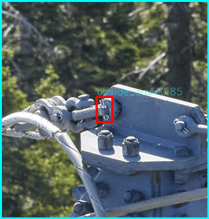
By associating those findings with information of the tower on which the upside-down cotter pins were located, the public utility could identify which towers required attention instantly. This approach has improved the efficiency and accuracy of identifying upside-down cotter pins and improved safety by having line workers only climbing structures when needed.
The utility also looked at other types of key components and their failure modes (flashed insulators, woodpecker damage on wooden transmission towers, rust on lattice towers, etc.) that could be identified utilizing this new approach for a proactive maintenance of powerlines. C-hooks and shackles, which are used for affixing insulators to brackets attached to crossarms, are particularly important components to look at in this context. The lattice towers are over 50 years old. Nonetheless, the virtual detection system was able to identify over 25,000 crops of C-hooks and shackles on the images captured during the inspection and very little wear was detected.
Figure 2: Examples of (a) a c-hook in good condition, (b) very limited level of wear seen on c-hooks during the project and (c) a shackle, highlighting the general good condition of those components in the grid.


Utilities are constantly looking for innovative ways to improve safety inspection and grid maintenance. This project has demonstrated that well-designed solutions supported by AI are game-changing tools, making inspection easier, more efficient and safer. The collaborative AI approach was instrumental to ensuring the correct components were identified and defects detected. The construction company’s review of the results from eSmart Systems’ Grid Vision solution ensured that high quality inspection standards were met and illustrated how utilities and engineering companies can benefit from virtual inspection tools.
The success of this program demonstrates how proactive actions can be implemented to enhance power grid management efficiency, and proves that smart solutions could help prevent wildfires, in addition to illustrating numerous other advantages, such as new quality assessment possibilities, defect detection standardization, and increased trust in data.
Contact us today and see how Grid Vision is transforming the way the world’s leading energy providers inspect and maintain critical infrastructure.
[1]https://www.nfpa.org/News-and-Research/Publications-and-media/NFPA-Journal/2020/November-December-2020/Features/Wildfire