Wildfires are intensifying across the U.S., with utilities facing unprecedented challenges as these disasters threaten grid infrastructure and customer safety. Traditional reactive approaches are no longer sufficient, as utilities struggle to balance operational reliability with the growing need for proactive, data-driven risk management in an increasingly volatile climate landscape.
This webinar reveals how leading utilities are transforming their wildfire mitigation strategies through AI-powered solutions, predictive insights and digital grid asset management. Industry experts share proven methodologies for anticipating risks, optimizing maintenance schedules, and maintaining grid resilience while reducing wildfire exposure.
Explore:
- How digitalization of grid assets enhances wildfire risk visibility and supports smarter decision-making
- Real-world applications of AI and geospatial analysis in proactive threat prevention
- Strategies for combining risk assessment with predictive maintenance for faster, smarter risk mitigation

How does Grid Vision work with national wildfire agencies like NIFC, and does government shutdown impact data availability?
We use the best available private utility data as well as public wildfire and situational data, as appropriate. As an asset management and planning tool, our platform is designed to operate independently and not reliant on government data feeds, ensuring continuous access to inspection insights, asset health indicators, and high-risk component detection.
Are insurance carriers working with utilities to strengthen wildfire risk programs?
Yes. We see growing collaboration between insurers and utilities to reduce financial exposure. Grid Vision helps utilities provide objective evidence of proactive maintenance and risk reduction, which supports insurance discussions and lowers long-term risk costs.
Which regions outside the Western United States are most exposed to wildfire risk and need predictive mitigation tools?
Wildfire risk is rising in the Mountain States, Texas, the Southeast, and parts of the Northeast due to climatic shifts and expanding electrification. We are seeing strong interest in predictive wildfire programs in Canada and Europe, particularly in regions with aging overhead networks near vegetation and communities.
How do you help cost-sensitive utilities justify investment in AI and wildfire mitigation technology?
We focus on operational outcomes. Utilities using Grid Vision report faster inspections, reduced helicopter and field exposure, better prioritization of capital work, and lower likelihood of ignition events. Early, targeted action reduces long-term costs and improves customer and regulator confidence.
Can Grid Vision use Vexcel imagery or other high-resolution aerial datasets?
Yes. Grid Vision is data-flexible and supports Vexcel and similar providers when available. When coverage gaps exist, we work with utilities and partners to capture imagery using drones, helicopters, or satellite data at the appropriate resolution. We’re agnostic to the data capture hardware, as long as it meets the resolution requirements to power Grid Vision’s analytics.
Do you support regions where high-resolution imagery is limited, such as parts of California or Los Angeles?
We help utilities deploy the right capture approach for their network. Grid Vision supports RGB, LiDAR, and thermal data so utilities can expand coverage quickly and build consistent inspection programs that scale across all assets.
During an active wildfire, can Grid Vision account for incident team strategies and tactics?
We provide an accurate view of asset intelligence and geospatial context from recent image capture, to help utilities understand system risks. Utilities can overlay incident response zones and suppression perimeters to support prioritization and restoration decision making.
How close is the industry to integrating operational system data with weather, imagery, and geospatial intelligence?
Utilities are moving rapidly to connect asset condition data with outage events, line faults, weather, and vegetation. Grid Vision can feed risk insights into operational and planning systems, helping utilities focus efforts where the grid and the environment create the highest ignition potential. With our public APIs our strategy is to be a proponent of an integrated ecosystem approach, to deliver the best outcomes for our customers.
What type of weather data does Grid Vision require to support proactive wildfire mitigation?
We use surface-based measurements where available, along with environmental data such as wind, temperature, drought indices, and vegetation, which can be overlayed in Grid Vision. Combined with inspection intelligence, this supports identification of high-risk components and zones by combining these data sets for blended risk assessment.
How do you reduce false positives and maintain trust in AI inspection results?
Our models are trained with utility-validated data and continuously improved through operator feedback using our VerifyAI processes. Utilities control acceptance of findings, and every insight includes traceable image evidence so decisions remain accurate, transparent, and auditable.
Other Webinars You May Like
-
 Webinars
Watch our webinar – Disrupting the status quo: AI in utility operations
Watch this webinar to understand why everyone is talking about AI transforming utilities’ day-to-day operations and business as a whole. Learn what leaders really need to know about these fast-moving technological changes.September 25th 2024 -
 Webinars
Watch our webinar – Master your substation asset data: Expert insights and strategies revealed
Watch this webinar to learn how to improve poor quality and incomplete data for your substations and how you can achieve lower costs and a much faster response to faulty assets by relying on accurate, up-to-date data.May 09th 2023 -
 Webinars
Watch our webinar – Incorrect asset data – why it puts congestion management strategies at risk
Stedin, DSO for 2.3+ million customers in the Netherlands, realised that the asset data they used for their network calculations resulted in anomalies. Watch this webinar to understand Stedin’s approach to validating asset data for their 22,000 Medium Voltage substations.October 02nd 2023 -
 Webinars
Watch our webinar – How AI & Virtual inspections changed operations at Xcel Energy
Inspecting transmission and distribution assets is tremendously time- and labor-intensive for utilities. Watch this webinar to learn the benefits and requirements of using a virtual inspection program and what AI is and isn’t capable of doing.May 12th 2023

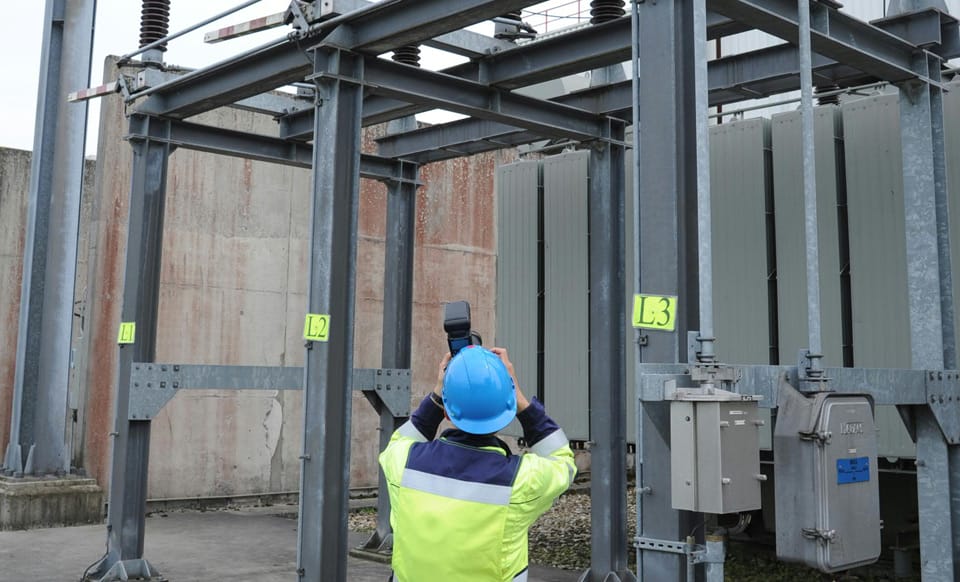



In this whitepaper, learn what to consider and how you can realize the benefits of the new generation of infrastructure inspections and increase the resiliency of your power grid.
Wildfires are intensifying across the U.S., with utilities facing unprecedented challenges as these disasters threaten grid infrastructure and customer safety. Traditional reactive approaches are no longer sufficient, as utilities struggle to balance operational reliability with the growing need for proactive, data-driven risk management in an increasingly volatile climate landscape.
This webinar reveals how leading utilities are transforming their wildfire mitigation strategies through AI-powered solutions, predictive insights and digital grid asset management. Industry experts share proven methodologies for anticipating risks, optimizing maintenance schedules, and maintaining grid resilience while reducing wildfire exposure.
Explore:
- How digitalization of grid assets enhances wildfire risk visibility and supports smarter decision-making
- Real-world applications of AI and geospatial analysis in proactive threat prevention
- Strategies for combining risk assessment with predictive maintenance for faster, smarter risk mitigation
Other Webinars You May Like
-
Webinars
Watch our webinar – Disrupting the status quo: AI in utility operations
Watch this webinar to understand why everyone is talking about AI transforming utilities’ day-to-day operations and business as a whole. Learn what leaders really need to know about these fast-moving technological changes.September 25th 2024 -
Webinars
Watch our webinar – Master your substation asset data: Expert insights and strategies revealed
Watch this webinar to learn how to improve poor quality and incomplete data for your substations and how you can achieve lower costs and a much faster response to faulty assets by relying on accurate, up-to-date data.May 09th 2023 -
Webinars
Watch our webinar – Incorrect asset data – why it puts congestion management strategies at risk
Stedin, DSO for 2.3+ million customers in the Netherlands, realised that the asset data they used for their network calculations resulted in anomalies. Watch this webinar to understand Stedin’s approach to validating asset data for their 22,000 Medium Voltage substations.October 02nd 2023 -
Webinars
Watch our webinar – How AI & Virtual inspections changed operations at Xcel Energy
Inspecting transmission and distribution assets is tremendously time- and labor-intensive for utilities. Watch this webinar to learn the benefits and requirements of using a virtual inspection program and what AI is and isn’t capable of doing.May 12th 2023
Wildfires are intensifying across the U.S., with utilities facing unprecedented challenges as these disasters threaten grid infrastructure and customer safety. Traditional reactive approaches are no longer sufficient, as utilities struggle to balance operational reliability with the growing need for proactive, data-driven risk management in an increasingly volatile climate landscape.
This webinar reveals how leading utilities are transforming their wildfire mitigation strategies through AI-powered solutions, predictive insights and digital grid asset management. Industry experts share proven methodologies for anticipating risks, optimizing maintenance schedules, and maintaining grid resilience while reducing wildfire exposure.
Explore:
- How digitalization of grid assets enhances wildfire risk visibility and supports smarter decision-making
- Real-world applications of AI and geospatial analysis in proactive threat prevention
- Strategies for combining risk assessment with predictive maintenance for faster, smarter risk mitigation
Other Webinars You May Like
-
Webinars
Watch our webinar – Disrupting the status quo: AI in utility operations
Watch this webinar to understand why everyone is talking about AI transforming utilities’ day-to-day operations and business as a whole. Learn what leaders really need to know about these fast-moving technological changes.September 25th 2024 -
Webinars
Watch our webinar – Master your substation asset data: Expert insights and strategies revealed
Watch this webinar to learn how to improve poor quality and incomplete data for your substations and how you can achieve lower costs and a much faster response to faulty assets by relying on accurate, up-to-date data.May 09th 2023 -
Webinars
Watch our webinar – Incorrect asset data – why it puts congestion management strategies at risk
Stedin, DSO for 2.3+ million customers in the Netherlands, realised that the asset data they used for their network calculations resulted in anomalies. Watch this webinar to understand Stedin’s approach to validating asset data for their 22,000 Medium Voltage substations.October 02nd 2023 -
Webinars
Watch our webinar – How AI & Virtual inspections changed operations at Xcel Energy
Inspecting transmission and distribution assets is tremendously time- and labor-intensive for utilities. Watch this webinar to learn the benefits and requirements of using a virtual inspection program and what AI is and isn’t capable of doing.May 12th 2023
Wildfires are intensifying across the U.S., with utilities facing unprecedented challenges as these disasters threaten grid infrastructure and customer safety. Traditional reactive approaches are no longer sufficient, as utilities struggle to balance operational reliability with the growing need for proactive, data-driven risk management in an increasingly volatile climate landscape.
This webinar reveals how leading utilities are transforming their wildfire mitigation strategies through AI-powered solutions, predictive insights and digital grid asset management. Industry experts share proven methodologies for anticipating risks, optimizing maintenance schedules, and maintaining grid resilience while reducing wildfire exposure.
Explore:
- How digitalization of grid assets enhances wildfire risk visibility and supports smarter decision-making
- Real-world applications of AI and geospatial analysis in proactive threat prevention
- Strategies for combining risk assessment with predictive maintenance for faster, smarter risk mitigation
Other Webinars You May Like
-
Webinars
Watch our webinar – Disrupting the status quo: AI in utility operations
Watch this webinar to understand why everyone is talking about AI transforming utilities’ day-to-day operations and business as a whole. Learn what leaders really need to know about these fast-moving technological changes.September 25th 2024 -
Webinars
Watch our webinar – Master your substation asset data: Expert insights and strategies revealed
Watch this webinar to learn how to improve poor quality and incomplete data for your substations and how you can achieve lower costs and a much faster response to faulty assets by relying on accurate, up-to-date data.May 09th 2023 -
Webinars
Watch our webinar – Incorrect asset data – why it puts congestion management strategies at risk
Stedin, DSO for 2.3+ million customers in the Netherlands, realised that the asset data they used for their network calculations resulted in anomalies. Watch this webinar to understand Stedin’s approach to validating asset data for their 22,000 Medium Voltage substations.October 02nd 2023 -
Webinars
Watch our webinar – How AI & Virtual inspections changed operations at Xcel Energy
Inspecting transmission and distribution assets is tremendously time- and labor-intensive for utilities. Watch this webinar to learn the benefits and requirements of using a virtual inspection program and what AI is and isn’t capable of doing.May 12th 2023

Wildfires are intensifying across the U.S., with utilities facing unprecedented challenges as these disasters threaten grid infrastructure and customer safety. Traditional reactive approaches are no longer sufficient, as utilities struggle to balance operational reliability with the growing need for proactive, data-driven risk management in an increasingly volatile climate landscape.
This webinar reveals how leading utilities are transforming their wildfire mitigation strategies through AI-powered solutions, predictive insights and digital grid asset management. Industry experts share proven methodologies for anticipating risks, optimizing maintenance schedules, and maintaining grid resilience while reducing wildfire exposure.
Explore:
- How digitalization of grid assets enhances wildfire risk visibility and supports smarter decision-making
- Real-world applications of AI and geospatial analysis in proactive threat prevention
- Strategies for combining risk assessment with predictive maintenance for faster, smarter risk mitigation
Other Webinars You May Like
-
Webinars
Watch our webinar – Disrupting the status quo: AI in utility operations
Watch this webinar to understand why everyone is talking about AI transforming utilities’ day-to-day operations and business as a whole. Learn what leaders really need to know about these fast-moving technological changes.September 25th 2024 -
Webinars
Watch our webinar – Master your substation asset data: Expert insights and strategies revealed
Watch this webinar to learn how to improve poor quality and incomplete data for your substations and how you can achieve lower costs and a much faster response to faulty assets by relying on accurate, up-to-date data.May 09th 2023 -
Webinars
Watch our webinar – Incorrect asset data – why it puts congestion management strategies at risk
Stedin, DSO for 2.3+ million customers in the Netherlands, realised that the asset data they used for their network calculations resulted in anomalies. Watch this webinar to understand Stedin’s approach to validating asset data for their 22,000 Medium Voltage substations.October 02nd 2023 -
Webinars
Watch our webinar – How AI & Virtual inspections changed operations at Xcel Energy
Inspecting transmission and distribution assets is tremendously time- and labor-intensive for utilities. Watch this webinar to learn the benefits and requirements of using a virtual inspection program and what AI is and isn’t capable of doing.May 12th 2023
Wildfires are intensifying across the U.S., with utilities facing unprecedented challenges as these disasters threaten grid infrastructure and customer safety. Traditional reactive approaches are no longer sufficient, as utilities struggle to balance operational reliability with the growing need for proactive, data-driven risk management in an increasingly volatile climate landscape.
This webinar reveals how leading utilities are transforming their wildfire mitigation strategies through AI-powered solutions, predictive insights and digital grid asset management. Industry experts share proven methodologies for anticipating risks, optimizing maintenance schedules, and maintaining grid resilience while reducing wildfire exposure.
Explore:
- How digitalization of grid assets enhances wildfire risk visibility and supports smarter decision-making
- Real-world applications of AI and geospatial analysis in proactive threat prevention
- Strategies for combining risk assessment with predictive maintenance for faster, smarter risk mitigation
Other Webinars You May Like
-
Webinars
Watch our webinar – Disrupting the status quo: AI in utility operations
Watch this webinar to understand why everyone is talking about AI transforming utilities’ day-to-day operations and business as a whole. Learn what leaders really need to know about these fast-moving technological changes.September 25th 2024 -
Webinars
Watch our webinar – Master your substation asset data: Expert insights and strategies revealed
Watch this webinar to learn how to improve poor quality and incomplete data for your substations and how you can achieve lower costs and a much faster response to faulty assets by relying on accurate, up-to-date data.May 09th 2023 -
Webinars
Watch our webinar – Incorrect asset data – why it puts congestion management strategies at risk
Stedin, DSO for 2.3+ million customers in the Netherlands, realised that the asset data they used for their network calculations resulted in anomalies. Watch this webinar to understand Stedin’s approach to validating asset data for their 22,000 Medium Voltage substations.October 02nd 2023 -
Webinars
Watch our webinar – How AI & Virtual inspections changed operations at Xcel Energy
Inspecting transmission and distribution assets is tremendously time- and labor-intensive for utilities. Watch this webinar to learn the benefits and requirements of using a virtual inspection program and what AI is and isn’t capable of doing.May 12th 2023
The project, completed in 2021, focused on hardware and defects identification. The project looked at cotter pins, with an emphasis on loose and upside-down cotter pins. The project was able to automatically detect over 11,000 total and successfully identify 781 upside-down pins within a few seconds. The project enabled the public utility’s maintenance engineers to efficiently locate the 2-inch upside-down cotter pins on up to 100 feet high towers and assess their conditions. The outcome of the project is an increase in powerline safety, field worker safety, and, as result, community safety. The case-study described below demonstrates the potential of virtual powerline inspections in enhancing community safety.
Introduction
Multiple large-scale wildfires are reported in the US every year. Such events cost tens of billions of dollars in direct costs such as property loss and damage and indirect costs such as long-term health exposures, market loss, and non-collectable taxes, etc[1]. The consequences of such events can be disastrous from a human, material, and environmental perspective.
Defects in the power grid can cause wildfires; active causes can include a tree or branch falling over a powerline and sparking a wildfire. Triggered material or old powerline components can generate arcs or sparks, and under dry weather conditions and with dry surrounding vegetation, can lead to disastrous and hard to control wildfires.
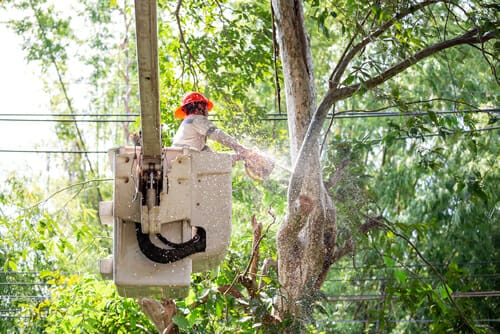
To minimize the risk of wildfires caused by power grid issues, it is important to ensure conductors do not encounter any foreign objects like trees, other conductors, or the ground. This can only be achieved by properly managing vegetation in areas surrounding powerlines and by sufficiently keeping conductors separate from each other. Spacers and cotter pins, specifically, play a critical role in keeping conductors separated. Spacers keep conductors away from each other, while cotter pins hold the parts in transmission towers in place.
Cotter pins, however, could wear out and loosen over time. A loose and upside-down cotter pin is more likely to slip, becoming unsafe and increasing the chance of conductor failure and the probability of generating an arc flash touching their surroundings. Therefore, a main focus of the efforts led by the public utility to minimize the chance of wildfires is the management and maintenance of cotter pins specifically. As they are more likely to be upside-down than loose, the public utility decided to first assess the number of upside-down cotter pins on their grid. However, manually identifying the orientation of cotter pins is a tedious and resource-consuming task, as there can be as many as 50 2-inch cotter pins on each lattice tower, and the grid in this case includes over 1000 lattice towers.
The new approach
Both the public utility and the engineering and construction company defined the inspection process based on the required scope and accessibility of each structure. eSmart Systems shared their expertise to support that process definition and provided access to Grid Vision, a virtual inspection solution for power grids, enabling professionals to inspect powerlines from the office. Virtual inspection is a new approach to conducting powerline inspections by leveraging the power of automation, smart algorithms, and user-friendly interfaces to facilitate the work of the professionals analyzing the status of the infrastructure. Virtual inspections are also supported with artificial intelligence (AI) to automatically and promptly identify all the components of a power grid, as well as to detect various failures in the grid. With the application of such technologies, the software was able to identify 781 instances of upside-down cotter pins out of 11,000 cotter pin crops, within seconds (Figure 1).
Figure 1: Examples of an upside-down cotter pin automatically detected in the grid.

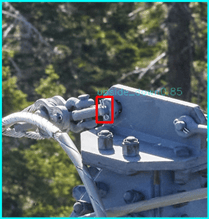
By associating those findings with information of the tower on which the upside-down cotter pins were located, the public utility could identify which towers required attention instantly. This approach has improved the efficiency and accuracy of identifying upside-down cotter pins and improved safety by having line workers only climbing structures when needed.
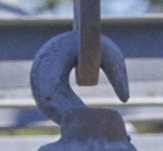
The utility also looked at other types of key components and their failure modes (flashed insulators, woodpecker damage on wooden transmission towers, rust on lattice towers, etc.) that could be identified utilizing this new approach for a proactive maintenance of powerlines. C-hooks and shackles, which are used for affixing insulators to brackets attached to crossarms, are particularly important components to look at in this context. The lattice towers are over 50 years old. Nonetheless, the virtual detection system was able to identify over 25,000 crops of C-hooks and shackles on the images captured during the inspection and very little wear was detected.
Figure 2: Examples of (a) a c-hook in good condition, (b) very limited level of wear seen on c-hooks during the project and (c) a shackle, highlighting the general good condition of those components in the grid.


Utilities are constantly looking for innovative ways to improve safety inspection and grid maintenance. This project has demonstrated that well-designed solutions supported by AI are game-changing tools, making inspection easier, more efficient and safer. The collaborative AI approach was instrumental to ensuring the correct components were identified and defects detected. The construction company’s review of the results from eSmart Systems’ Grid Vision solution ensured that high quality inspection standards were met and illustrated how utilities and engineering companies can benefit from virtual inspection tools.
The success of this program demonstrates how proactive actions can be implemented to enhance power grid management efficiency, and proves that smart solutions could help prevent wildfires, in addition to illustrating numerous other advantages, such as new quality assessment possibilities, defect detection standardization, and increased trust in data.
Contact us today and see how Grid Vision is transforming the way the world’s leading energy providers inspect and maintain critical infrastructure.
[1]https://www.nfpa.org/News-and-Research/Publications-and-media/NFPA-Journal/2020/November-December-2020/Features/Wildfire
Zeina Othman from Mälardalens University in Sweden is working in partnership with eSmart Systems on her thesis “Re-designing Organizational Routines in the Echo of AI Algorithms”. The overall objective of this thesis is to develop an understanding of how organizations need to re-design and influence processes when introducing and deploying Artificial Intelligence (AI).
eSmart Systems has been working with AI within our Grid Vision® solution for over 10 years, as a co-pilot for conducting virtual inspection of transmission and distribution grids through a process we call Collaborative-AI. We are working with over 50 utilities globally in supporting their journey to virtual inspections using Grid Vision.
Technology has a huge impact on large organizations in terms of processes, adoption, and change management, and we are thrilled to partner with Zeina to explore this journey with one of our key European customers.
Stayed tuned to learn more about Zenia’s work by signing up to our newsletter here: GridVision.com/newsletter
About Zeina Othman
Zeina Othman studies and teaches international project management at Mälardalens University in Sweden. Prior to her Ph.D. studies, Zeina worked in project management with the UN and non-governmental organizations in Jordan including USAID and Jordan River Foundation. She also worked in Abu Dhabi/UAE for Accenture and Lockheed Martin Global Inc.