Featuring:

  • Nhan Van Nguyen, Head of AI
  • Andreas Waal, Head of Engineering
  • Erik Åsberg, Chief Technology Officer
  • Maria Cervantes Keel, Senior Marketing Manager

The launch of AI Studio by eSmart Systems marks a meaningful shift in how we bring our technology to market. For over a decade, we’ve built computer vision AI for the power sector behind the scenes of Grid Vision, embedded in the workflows of more than 75 utilities worldwide. AI Studio is the moment we open that up, giving users access to the intelligence layer that powers our technology. I sat down with our Head of AI, Nhan Van Nguyen, and Head of Engineering, Andreas Waal, and our CTO Erik Åsberg, to talk about what we’ve built, why now, and what we’re already seeing from the people using it.

Maria: Nhan, let’s start with the basics. AI Studio – what is it, in plain terms?

Nhan Van Nguyen:
So excited that you asked. AI Studio is a full-stack computer vision AI platform that enables utilities and technology companies to create, explore and deploy production-ready models in minutes. It’s powered by our patent-pending Adaptive AI. In layman’s terms the platform that makes all of the AI capabilities that we’ve built at eSmart over the past decade accessible to customers as a service — through a web interface and APIs. There are three core components:

And all of it is API-first; natively ready for agentic workflows, so it integrates directly into whatever systems or AI agents you’re already running.

Maria: Andreas, from a product perspective: what problem were you solving?

Andreas Waal:
The honest version? We kept seeing the same friction. A utility would want to customize a model; say, adapting a defect classifier to match their internal standards rather than a generic definition, and the traditional process was just too heavy. You’d need labeled data, an ML pipeline, training time, and validation cycles.

Weeks, sometimes months, would pass before you’d see results. And if the definition changed, which it always does, you’d start the cycle over. That’s not how domain knowledge works in real operations. We wanted to build something that matches the pace of how people actually think and work..

Maria: What makes AI Studio genuinely different? There are plenty of computer vision tools out there.

Nhan:
At it’s core is what we call our patent-pending Adaptive AI technology. The key difference from standard fine-tuning or few-shot learning is that it’s not a one-off process. You provide a handful of example images, the model generates immediately. No training run, no annotation pipeline, and then it keeps improving as you give it feedback. When a definition changes, you update the examples and the model updates with it, in real time. There’s no retraining cycle to redo. That’s genuinely new.

The other thing that makes it different is what sits underneath it. We use foundation models as the feature extraction layer, the best available at any point in time. When a new, more capable foundation model comes out, our Adaptive AI inherits those gains automatically without any re-labeling or engineering effort. We benchmarked this directly: switching to a newer feature extractor model last year pushed our F1 accuracy on a crossarm classification task from 0.72 to 0.89 in under a minute. No additional data. No work. The model just got better because the world got better.

Erik Åsberg:
And for the user, that’s the part that matters. Traditional AI development asks you to commit a lot upfront: data collection, labeling, infrastructure, etc. before you know if it’s going to work. AI Studio inverts that. You can start with only a few images and a working model, then improve from there. It changes the risk calculus entirely.

Maria: So why open this up now to the public? eSmart Systems has had these capabilities internally for a while.

Erik:
Honestly, a few things came together. The underlying technology reached a point where we felt confident putting it in users’ hands directly; the Adaptive AI architecture is mature enough that it doesn’t need us as an intermediary. At the same time, we started seeing the AI landscape shift toward agentic workflows, where software isn’t built and deployed statically but assembled dynamically by AI agents. That world runs on APIs. And we realized that if we stayed inside a traditional SaaS model, we’d be limiting the future impact we could have as a product company. Opening our capabilities as modular, API-first services is how we stay relevant in the next era of enterprise software, not just the current one.

Andreas:
There’s also a practical pull from the market. The utilities and technology companies we talk to aren’t waiting for a perfect enterprise solution before they start experimenting. They want to try things, build something small, see if it works. The Free tier is a direct response to that. It lowers the floor enough that someone can go from zero to a working model in an afternoon. And they can confidently scale from there with AI Studio.

Maria: Who are you seeing use it now, and how?

Andreas:
The audience is broader than I originally expected. Utilities are the core, and the use cases there are what you’d predict; customizing inspection models to match their own asset definitions, building classifiers for defect conditions that are specific to their territory or equipment base. But we’re also seeing interest from technology companies that want to embed computer vision into their own products or platforms without building an ML team. And from inspection service providers who want to differentiate their offering. The API-first architecture makes AI Studio something you can build on top of, not just use.

Nhan:
What I find interesting is how quickly people get to the multi-model pipeline use case. Initially, you’d think someone picks one model and runs it. But the Pipeline Builder has resonated also. Classify something, measure it, chain the results into a workflow. That end-to-end composition is where the real value starts to show up operationally.

Maria: What’s surprised you? Things you didn’t predict when you were building it.

Andreas:
The speed at which people get creative with non-utility applications. We designed AI Studio with grid inspection as the primary context, but the architecture is domain-agnostic, and users figured that out fast. We’ve seen early interest from people applying it to use cases well outside of power; environmental monitoring, industrial inspection, things we’d never scoped, including even classifying flower species in images. That’s genuinely exciting. And it validates the approach: build something flexible at the architecture level and don’t try to constrain the use case too tightly.

Erik:
For me, the moment that stood out was watching someone build a working model in a product demo, from scratch, no prior examples, in about twelve minutes, and have it performing in a meaningful way by the end of the session. Opening it to the world, and seeing what users are creating in real time keeps me excited about what we’ve actually built.

Maria: Where are you excited to take it next?

Nhan:
The biggest thing I’m watching is how AI Studio fits into agentic workflows – where AI agents are calling our capabilities directly as tools, not as a platform a human logs into. We’ve designed the API layer with that in mind from the start. What I want to see is AI Studio becoming the computer vision reasoning layer inside broader, multi-agent systems. A planning agent that delegates visual inspection tasks to an eSmart Systems’ model and gets structured results back. That’s where this gets genuinely interesting at scale.

Erik:
From a product side, the near-term focus is on reducing every point of friction in the experience – from signup to first working model to first API call. The Pro tier we’re planning will open up the Model Garden to a broader audience at a lower commitment point than Enterprise, which I think unlocks a whole segment of users who are serious outside of big enterprise use cases. And then the longer arc is about making AI Studio the tool that anyone building visual AI in an industrial context defaults to, not just because of the technology, but because the experience and performance is genuinely better than the alternatives.

Maria: Last one – for someone reading this who’s been sitting on the sideline on AI, utility team, technology company, inspection professional, what would you tell them?

Andreas:
Try it. The Free tier is exactly what it says – no commitment, no sales process, no ML team required. Upload some images, build a model, see what it does. The best way to understand what AI Studio changes is to use it. You won’t regret trying it.

Nhan:
And don’t assume the constraint is data. The barrier has never really been data volume, it’s been the overhead of the process around the data. That’s what Adaptive AI removes. If you have a use case in mind and a handful of examples, that’s enough to start.

Want to build your first model?

Sign up for the AI Studio Free tier at ai.esmartsystems.com – no ML expertise, no labeling pipeline, no training cycles required. Start with a handful of images and have a working model in minutes.

Ready to go further? Reach out to our team about Enterprise access.

Traditional approaches to transmission and distribution planning are no longer sufficient in the face of accelerating demand growth, extreme weather events, aging infrastructure, and a changing supply mix. Utilities need new strategies that leverage internal and customer side advanced digital capabilities, with a focus on breaking down internal and external stakeholder silos to meet these challenges head-on. 

This webinar will explore two critical innovations shaping the future of T&D grid planning and resilience. First, how AI-driven digital twins and risk modeling can give utilities a true, component-level view of asset health, enabling smarter prioritization of capital investments and preventative maintenance programs—while reducing critical extreme weather failure exposure such as ignition risk in wildfire-prone areas. Second, how flexible interconnection strategies, already being applied to large loads like data centers, can help utilities integrate new demand – quicker, cheaper, and more equitable – without compromising reliability or resilience. 

Join us for practical insights, utility case studies, and an interactive Q&A session with industry leaders from Camus Energy and eSmart Systems. Learn how these approaches can help utilities move beyond traditional T&D planning toward a more adaptive, resilient future. 

Screenshot 2026-02-26 144908

Answers to the top questions from the webinar


How do AI-driven digital twins improve capital prioritization across transmission and distribution?

AI-powered digital twins provide component-level visibility across the network, allowing utilities to quantify asset condition, risk exposure, and performance constraints in one environment. Instead of relying on age-based replacement cycles, utilities can prioritize investments based on actual condition, system impact, and resilience outcomes – improving capital efficiency while reducing risk.

What does true T&D coordination look like in a modern grid environment?

It means moving beyond siloed planning. Transmission and distribution must share real-time and planning-level intelligence, including asset condition, load growth, DER penetration, and system constraints. When digital twins and orchestration platforms work together, utilities can align capital planning, operations, and distributed resource strategies to avoid stranded investments and improve reliability.

How can digital technologies reduce extreme weather exposure?

By combining asset condition data, geospatial intelligence, and environmental risk overlays, utilities can identify vulnerable components before an event occurs. This enables targeted hardening, proactive maintenance, and better emergency planning, reducing outage duration, safety exposure, and restoration costs.

How does component-level intelligence change grid planning decisions?

When planners understand the health and risk profile of individual poles, conductors, and substation components, they can distinguish between localized issues and system-wide constraints. This precision prevents overbuilding, improves upgrade timing, and supports more adaptive infrastructure investments.

How do digital twins support long-term resilience strategies?

They create a continuously updated model of the physical grid, linking inspection insights, operational data, and risk indicators. This enables utilities to simulate scenarios, evaluate hardening strategies, and justify resilience investments with defensible, data-backed evidence.

What is the biggest shift utilities must make to move beyond traditional T&D models?

The shift is from reactive infrastructure management to predictive, coordinated grid intelligence. That means integrating condition data, operational visibility, and distributed resource management into a unified strategy. Utilities that embrace this approach are better positioned to manage electrification, climate risk, and evolving reliability expectations.

Other Webinars You May Like

May 2025 – Fingrid, Finland’s transmission system operator, has launched a strategic initiative to enhance grid maintenance in collaboration with eSmart Systems, a leader in critical grid asset management solutions. The project focuses on the conditional analysis of Fingrid’s Extra High Voltage (EHV) portfolio, leveraging advanced aerial data capture and virtual inspections using GridVision® software to improve grid reliability, safety, and sustainability.

Modernizing data capture and virtual inspections

As part of this initiative, Fingrid partnered with eSmart Systems and Airpelago. The project utilized automated flight patterns to capture data across 400 kV towers and spans along three powerlines. This approach introduced virtual inspections, significantly reducing the need for physical fieldwork and planned outages.

The captured data is processed in Grid Vision®, enabling Fingrid’s maintenance service providers to conduct comprehensive inspections more efficiently and with less reliance on on-site visits. Grid Vision® delivers a complete overview of each transmission tower’s condition, supporting proactive maintenance decisions and strengthening Fingrid’s overall asset management strategy. By digitalizing inspections, Fingrid is achieving improved data accuracy, new asset insights, enhanced safety, and high-quality decision-making data.

Our commitment to adopting innovative technologies allows us to enhance the security of supply while adhering to stringent safety and sustainability objectives. By integrating automated data capture with the competence of our maintenance personnel, we gain a clearer picture of our grid’s condition, enabling proactive interventions that improve operational efficiency, safety, and reliability.

Mikko Jalonen
Technology Manager, Fingrid

Fingrid’s vision for a sustainable grid

Fingrid continues to pursue technological advancements that support effective, data-driven grid maintenance. With the increasing complexity of energy transmission and rising sustainability expectations, the company remains committed to securing Finland’s energy supply while promoting a clean, market-based power system.

As Finland’s national transmission system operator, Fingrid plays a vital role in balancing electricity production and consumption. Through its extensive network, the company ensures the seamless flow of electricity across borders, connecting Finland to the Nordic and Central European power systems.

This project underscores Fingrid’s forward-thinking approach to grid management and reinforces its mission to provide uninterrupted electricity access, improve inspection safety, and accelerate digitalization in support of a more resilient and sustainable energy infrastructure.

We are proud to support Fingrid’s digitalization program. Our Grid Vision® solution aligns with their strategic goals for grid development and sustainability, while enabling service providers to conduct inspections more safely. The asset data within Grid Vision® will support preventive maintenance and asset management strategies to deliver clean, affordable, and reliable power to their customers.

Henrik Bache
CEO, eSmart Systems

About Fingrid

Fingrid Oyj is Finland’s transmission system operator, owned by the Finnish state and pension insurance companies. The company ensures a stable and secure electricity supply across the nation, transmitting electricity through the high-voltage network from production facilities to industrial consumers and electricity companies. As part of the joint Nordic power system, Fingrid plays a vital role in maintaining energy security and enabling cross-border electricity trade, ensuring a reliable and efficient power market.

About eSmart Systems

Smart Systems is a leading provider of AI-powered solutions for the inspection and maintenance of critical infrastructure. Through our software solution, GridVision®, we revolutionize how utility companies operate and maintain their transmission and distribution grids. We support utilities worldwide in reducing inspection costs, making inspections safer, improving asset data quality, and prolonging asset life by providing an image-based digital inventory representing all physical grid assets. eSmart Systems has more than 20 years of international experience in establishing and operating knowledge-based IT and energy-related companies targeting global markets.

AI is no longer a distant promise for utilities. It’s already helping grid operators streamline inspections, identify defects, and generate insights from asset data. These use cases offer real value, but common AI misconceptions often lead to AI being applied too narrowly and evaluated in isolation, without thinking through the larger system it needs to serve. An IEEE report states that up to 80% of AI projects fail to deliver value, and 87% never make it into production¹. Many of these failures are tied to insufficient, siloed, or ungoverned data, these don’t get fix by only focusing on better AI models.

That’s where progress can slow down. When AI is seen as the main objective rather than a component of a broader strategy, utilities can risk investing in tools that don’t scale, models built on poor-quality data, and insights that never reach frontline operations.

This article unpacks some of the most common AI misconceptions for utilities, and shows how shifting the mindset toward developing grid-wide intelligence vs just putting a magnifying glass on AI, can drive real, operational outcomes.

Once the POC works, are we ready to scale?

Most utilities start their AI journey with a proof of concept (POC). Pilot projects often succeed because they’re run in a bubble with controlled data, clear goals, and limited variability.

In the real world, scaling means not just the AI models, but the entire system: data quality, validation loops, human workflows, and the people. POCs don’t prove readiness, they prove potential. That’s an important difference.

That’s why it’s critical to partner with a team with proven operational experience at scale, because scaling requires more than good AI. It demands a holistic understanding of data, utility operations, and what it takes to make innovative technology work under real operational pressures and changing conditions.

Does more data mean better AI results?

Utilities sit on mountains of asset data, but volume isn’t the issue. Enough data is key, but quality matters far more than quantity. According to a study, 70% of AI projects fail to meet their goals in large part due to issues with data quality². To succeed, you want to know exactly what data you’re working with, how it’s been used, and whether it’s reliable. That requires version control, structured datasets, and a clear distinction between training, testing, and validation sets.

We have proven that in practice, more data isn’t always better. At eSmart Systems, we have reduced certain datasets from 500,000 to 100,000 images and achieved better outcomes by focusing on quality over quantity. By removing noise, correcting labels, and structuring data more effectively, the team achieved more accurate and explainable results. Uplifting data quality led to stronger model performance and greater trust in the results.

Should AI be the main goal?

AI isn’t the goal, better decisions are. High model accuracy means little if it doesn’t improve how you manage risk, respond to outages, or plan investments.

The real shift happens when utilities stop implementing AI as the destination and instead focus on building grid intelligence – structured, connected data that powers the entire operation. Inspections can be a key part of this shift, by capturing consistent, high-quality asset data that feeds a central digital model of the grid. With a central digital asset, operational teams can identify defects and inventory gaps in one platform, while planners prioritize investments based on condition, not assumptions. It also enables faster responses to weather events and ensures regulatory reports are grounded in real inspection data and not estimates.

Some major utilities (read more here) have made that leap, turning inspection programs into digital asset platforms that now drive maintenance, capital planning, and regulatory reporting.

Why look at the bigger picture?

Utilities face unprecedented challenges: load growth, renewable integration, aging infrastructure, and extreme weather. The old model: manual inspections, disconnected data, reactive maintenance – can’t keep up.

Grid intelligence platforms powered by AI, like Grid Vision, don’t just modernize inspections. They turn inspections into structured intelligence that supports every layer of grid operations. With visibility of asset condition down to component level, grid operators can act before problems escalate, avoiding outages, extending asset life, and allocating resources where they matter most. Focus on decisions, not just AI hype. Treat data as a strategic asset, not a byproduct. Building the intelligence layer your grid needs means investing in technology and processes that support risk mitigation at scale. AI plays a role, but shouldn’t be the only goal. Operational value is unlocked when data, insight, and action come together to drive smarter decisions for a stronger, more resilient grid.

Want to chat with our team about AI for utilities? Fill this form here  

Source¹: https://ieeexplore.ieee.org/document/10572277/metrics#metrics Source²: https://www.mckinsey.com/capabilities/mckinsey-digital/our-insights/a-data-leaders-technical-guide-to-scaling-gen-ai?

CEATI T&D 2023
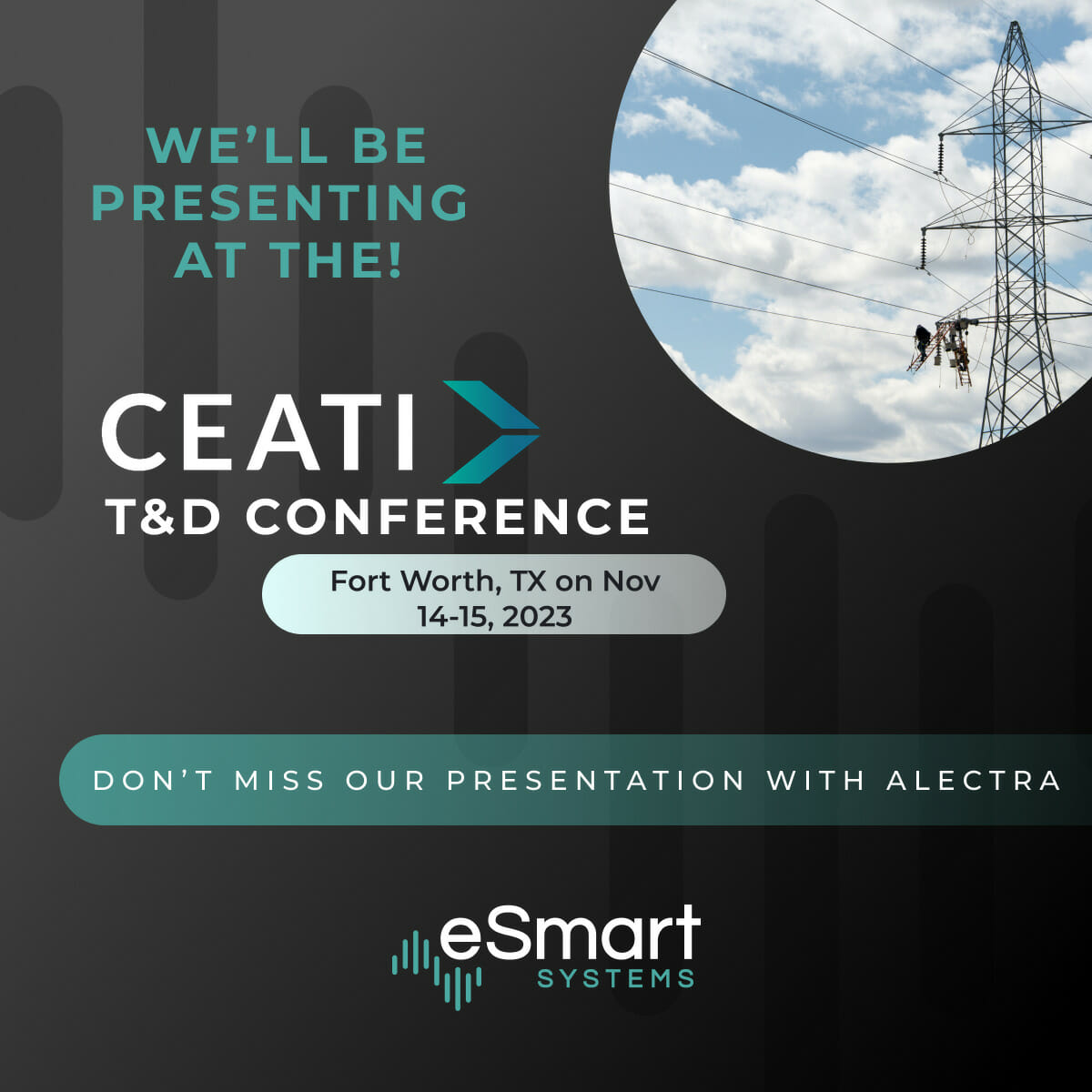
We’ll be presenting with Alectra at CEATI T&D!

We are pleased to announce that eSmart Systems will be participating in the upcoming Transmission & Distribution Conference organized by CEATI. We are looking forward to connecting with customers and partners.

We are particularly excited to share that we will be delivering a presentation in collaboration with Alectra, showcasing our joint project. Additionally, we invite attendees to visit our booth #104, where they can learn more about our cutting-edge inspection solutions and discuss how eSmart Systems can support their specific needs.

Contact us if you would like to book a demo at the event.

CEATI T&D 2023
We’ll be presenting with Alectra at CEATI T&D!

We are pleased to announce that eSmart Systems will be participating in the upcoming Transmission & Distribution Conference organized by CEATI. We are looking forward to connecting with customers and partners.

We are particularly excited to share that we will be delivering a presentation in collaboration with Alectra, showcasing our joint project. Additionally, we invite attendees to visit our booth #104, where they can learn more about our cutting-edge inspection solutions and discuss how eSmart Systems can support their specific needs.

Contact us if you would like to book a demo at the event.

CEATI T&D 2023
We’ll be presenting with Alectra at CEATI T&D!

We are pleased to announce that eSmart Systems will be participating in the upcoming Transmission & Distribution Conference organized by CEATI. We are looking forward to connecting with customers and partners.

We are particularly excited to share that we will be delivering a presentation in collaboration with Alectra, showcasing our joint project. Additionally, we invite attendees to visit our booth #104, where they can learn more about our cutting-edge inspection solutions and discuss how eSmart Systems can support their specific needs.

Contact us if you would like to book a demo at the event.

CEATI T&D 2023
We’ll be presenting with Alectra at CEATI T&D!

We are pleased to announce that eSmart Systems will be participating in the upcoming Transmission & Distribution Conference organized by CEATI. We are looking forward to connecting with customers and partners.

We are particularly excited to share that we will be delivering a presentation in collaboration with Alectra, showcasing our joint project. Additionally, we invite attendees to visit our booth #104, where they can learn more about our cutting-edge inspection solutions and discuss how eSmart Systems can support their specific needs.

Contact us if you would like to book a demo at the event.

CEATI T&D 2023
We’ll be presenting with Alectra at CEATI T&D!

We are pleased to announce that eSmart Systems will be participating in the upcoming Transmission & Distribution Conference organized by CEATI. We are looking forward to connecting with customers and partners.

We are particularly excited to share that we will be delivering a presentation in collaboration with Alectra, showcasing our joint project. Additionally, we invite attendees to visit our booth #104, where they can learn more about our cutting-edge inspection solutions and discuss how eSmart Systems can support their specific needs.

Contact us if you would like to book a demo at the event.

CEATI T&D 2023
We’ll be presenting with Alectra at CEATI T&D!

We are pleased to announce that eSmart Systems will be participating in the upcoming Transmission & Distribution Conference organized by CEATI. We are looking forward to connecting with customers and partners.

We are particularly excited to share that we will be delivering a presentation in collaboration with Alectra, showcasing our joint project. Additionally, we invite attendees to visit our booth #104, where they can learn more about our cutting-edge inspection solutions and discuss how eSmart Systems can support their specific needs.

Contact us if you would like to book a demo at the event.